
-
E-mail:
18333041899@163.com -
Tel:
86-18333041899
E-mail:
18333041899@163.comTel:
86-18333041899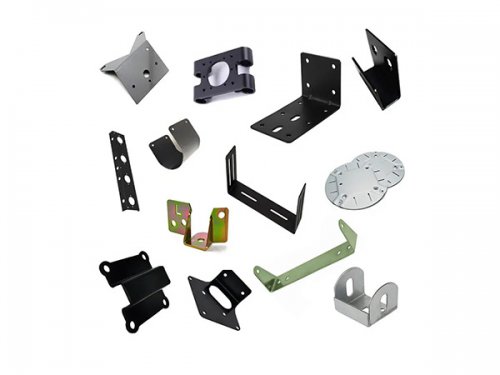
Bending Parts:A Fundamental Manufacturing Process
Bending is a pivotal sheet metal fabrication process where a flat sheet(or blank)is permanently deformed around a straight axis to create a V,U,or channel shape.It is a cost-effective and efficient method for transforming two-dimensional sheets into rigid,three-dimensional parts with high strength and geometric complexity.
1.Core Principle
The fundamental principle of bending involves applying force to a workpiece,causing plastic deformation.The outer surface of the bend is stretched(tension),while the inner surface is compressed.The region between them,which experiences neither,is called the neutral axis.
2.Key Terminology
To understand bending,several key terms are essential:
Bend Line:The straight line defining the location of the bend.
Bend Angle:The angle of the finished bend(e.g.,30°,90°).
Inside Radius(R):The internal radius of the bend.It is a critical factor determined by the tooling.
Bend Allowance(BA):The length of material along the neutral axis required for the bend.It is crucial for calculating the initial flat pattern size.
K-Factor:A dimensionless ratio used to calculate the bend allowance.It represents the location of the neutral axis.
Springback:The elastic recovery of the material after bending,causing the final bend angle to open slightly more than the tool angle.
3.Primary Bending Methods
Several techniques are employed in industry,each with unique advantages:
Press Brake Bending:The most common method.A punch presses the sheet into a V-die.
Air Bending:Versatile and requires less force;the punch does not force the metal to the bottom of the die.
Bottoming/Coining:High-force process where the punch forces the metal to conform exactly to the die shape,minimizing springback.
Folding:The sheet is clamped,and a beam pivots up to fold the material.Ideal for large panels and boxes.
Roll Bending:Used for creating large-radius curves or cylinders by passing the sheet through three adjustable rolls.
Rotary Bending:Uses a rotating die and is common in high-volume production for its speed and consistency.
4.The Bending Workflow
Design&Flattening:A 3D CAD model is"unfolded"into a flat pattern,with software calculating the bend allowance.
Blank Cutting:The flat pattern is cut from sheet stock(e.g.,by laser,plasma,or punch).
Tooling Setup:The appropriate punch and die are selected and installed on the press brake.
Machine Programming:The bend sequence,angles,and positions are programmed,often using CNC(Computer Numerical Control).
Forming:The operator positions the blank,and the machine executes the bends.
Inspection&Finishing:The final part is checked for dimensional accuracy and may undergo secondary operations like welding or painting.
5.Common Challenges&Defects
Springback:Compensated for by over-bending the material.
Cracking:Occurs if the bend radius is too tight for the material.
Warping/Twisting:Distortion caused by internal stresses;can be mitigated by optimizing the bend sequence.
6.Applications
Bent parts are ubiquitous across industries:
Enclosures:Electronics,computers,and machinery cabinets.
Automotive:Chassis frames,brackets,and body panels.
Aerospace:Structural airframe components.
Construction:HVAC ductwork,architectural elements.
Consumer Goods:Appliance housings,furniture,and brackets.
Summary
In conclusion,bending parts is a highly versatile and indispensable manufacturing process that adds strength and functionality to sheet metal.Its success relies on a deep understanding of material science,precise engineering calculations,and the selection of the appropriate bending technique to produce high-quality,durable components.