
-
E-mail:
18333041899@163.com -
Tel:
86-18333041899
E-mail:
18333041899@163.comTel:
86-18333041899
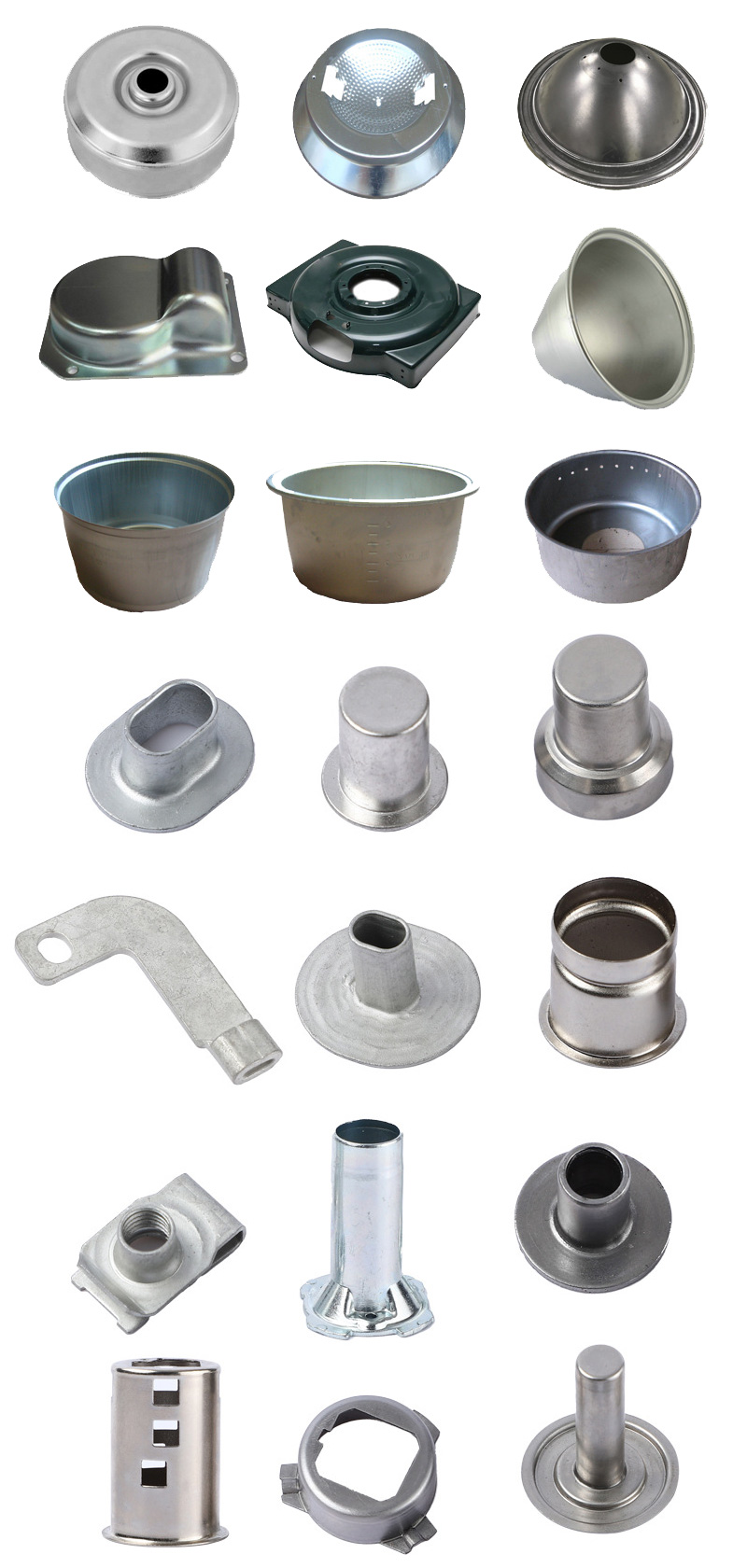
Tensile parts(also known as deep-drawn parts)are specialized sheet metal components fabricated through the tensile forming process—where flat metal blanks are pulled(stretched)into hollow,three-dimensional shapes using precision dies and presses.Characterized by uniform wall thickness,seamless structures,and high structural integrity,these parts are critical for applications requiring leak-proof,lightweight,or complex hollow geometries across automotive,aerospace,electronics,and consumer goods industries.Unlike standard bent or stamped sheet metal parts,tensile parts rely on controlled material flow under tensile stress to achieve depths greater than their diameter,making them ideal for enclosures,containers,and functional housings.
I.Core Definitions&Material Requirements
1.What Are Tensile Parts?
Tensile parts are formed via deep drawing—a cold-forming process that stretches sheet metal blanks over a punch and into a die cavity.The process involves radial tension and circumferential compression,ensuring the material maintains consistent thickness(variation≤±10%of original sheet thickness)while avoiding tearing or wrinkling.Key distinctions from other sheet metal parts include:
Hollow,closed-end geometries(e.g.,cups,cylinders,or irregular cavities).
Depth-to-diameter ratio(D/d)≥1(deep drawing)or<1(shallow drawing).
Seamless construction(no welding or assembly required for basic shapes).
2.Suitable Materials for Tensile Parts
Materials must exhibit excellent ductility,formability,and tensile strength to withstand the stretching process without failure.Common selections include:
Ferrous Metals:
Low Carbon Steel(1010,1018,Q235):High ductility(elongation≥25%),cost-effective,suitable for general-purpose tensile parts(containers,brackets).
Stainless Steel(304,316):Corrosion-resistant,good formability,ideal for food-grade containers,medical devices,and marine components.
Galvanized Steel:Rust-resistant,used in automotive fuel tanks,HVAC components.
Non-Ferrous Metals:
Aluminum Alloys(5052,6061,1100):Lightweight,excellent stretchability(elongation≥20%),suitable for electronics enclosures,aerospace housings.
Copper/Brass(C11000,C26000):High ductility and conductivity,used in electrical connectors,heat exchangers,and decorative tensile parts.
Titanium Alloys(Ti-6Al-4V):High strength-to-weight ratio,corrosion-resistant,for aerospace and medical implants(requires specialized dies).
Material Thickness Range:0.1mm to 6mm(optimal:0.3–3mm)for most industrial applications;thicker materials(up to 12mm)require heavy-duty presses and multi-stage drawing.
II.Key Manufacturing Processes for Tensile Parts
Tensile parts are produced through specialized deep drawing processes,often combined with secondary operations to refine functionality:
1.Core Tensile Forming Processes
Single-Stage Deep Drawing:For simple geometries(e.g.,shallow cups,small cylinders)with D/d≤2.The blank is formed in one press stroke,ideal for high-volume production.
Multi-Stage Deep Drawing:For complex or deep parts(D/d>2)such as automotive fuel tanks or large enclosures.The blank is gradually stretched through multiple die sets,with intermediate annealing(for high-strength materials)to relieve residual stress and prevent cracking.
Reverse Drawing:A secondary process that reverses the direction of stretching to create stepped or nested geometries(e.g.,double-walled cups,threaded housings).
Redrawing:Reduces the diameter and increases the depth of a previously drawn part,achieving higher D/d ratios(up to 10 for thin materials).
2.Supporting Processes
Blank Preparation:Cutting flat blanks from sheet metal coils using blanking dies(tolerance±0.05mm)to ensure uniform material flow.
Lubrication:Applying oil-based or water-based lubricants(e.g.,drawing oil,graphite)to reduce friction between the blank and dies,preventing scratches and material adhesion.
Trimming&Deburring:Removing excess material(flanges)and burrs from the drawn part to meet dimensional and surface requirements.
Secondary Forming:Punching holes,embossing features,or flanging edges to add functionality(e.g.,mounting points,reinforcing ribs).
Surface Finishing:Electroplating,powder coating,passivation,or polishing to enhance corrosion resistance,aesthetics,or conductivity.
III.Core Characteristics&Advantages
Seamless&Leak-Proof:One-piece construction eliminates welds or joints,making tensile parts ideal for fluid-containing applications(fuel tanks,hydraulic cylinders)or vacuum enclosures.
Uniform Wall Thickness:Controlled material flow ensures consistent thickness distribution,enhancing structural stability and load-bearing capacity.
High Precision:Dimensional tolerances range from±0.03mm to±0.1mm,with positional tolerance±0.05mm for critical features,enabled by precision die design(CNC machining+EDM).
Cost-Effective for High Volume:Automated production lines(coil feeding+multi-stage drawing)achieve cycle times of 10–50 parts per minute,reducing unit costs for large batches.
Lightweight&Strong:Cold forming enhances material tensile strength by 15–30%compared to raw sheet metal,delivering a superior strength-to-weight ratio for weight-sensitive applications.
IV.Typical Industry Applications
Tensile parts are integral to industries requiring hollow,high-integrity components:
Automotive:Fuel tanks,transmission housings,cylinder liners,door handles,and HVAC ducts—seamless design ensures leak resistance and durability.
Aerospace:Aircraft hydraulic reservoirs,instrument housings,engine components,and lightweight structural brackets(using aluminum/titanium alloys).
Electronics&Electrical:Battery casings,connector housings,heat sinks,and sensor enclosures—compact,seamless design protects internal components.
Consumer Goods:Stainless steel cookware(pans,pots),beverage cans,cosmetic containers,and household appliance parts(washing machine drums,refrigerator compartments).
Medical Devices:Surgical instrument handles,implantable components(titanium sleeves),and sterile containers—corrosion-resistant materials and seamless construction meet biocompatibility standards.
Industrial Equipment:Hydraulic cylinders,pump housings,pressure vessels,and fluid storage tanks—high structural integrity withstands extreme pressures.
V.Quality Control&Standards
1.Quality Assurance Measures
Dimensional Inspection:Coordinate Measuring Machines(CMM),laser scanners,and optical comparators verify critical dimensions(depth,diameter,wall thickness)and geometric accuracy.
Material Testing:Tensile tests(ASTM E8)to confirm post-forming strength;hardness tests(Rockwell B/C)to ensure material properties meet requirements.
Surface Quality Checks:Automated optical inspection(AOI)detects scratches,wrinkles,or tool marks;roughness tests(Ra≤0.8μm for decorative parts)ensure finish consistency.
Leak Testing:Pressure testing(air/water)or vacuum testing for fluid-containing parts,with leak rates≤1×10⁻⁶cc/s for critical applications.
Process Monitoring:Real-time tracking of press force,punch speed,and die temperature to detect material defects or die wear,preventing batch failures.
2.Industry Compliance Standards
International Standards:ISO 9001(quality management),IATF 16949(automotive),AS9100(aerospace),ISO 13485(medical devices).
Material Standards:ASTM A624(carbon steel for deep drawing),ASTM A240(stainless steel),ASTM B209(aluminum alloys).
Processing Standards:ISO 12100(press safety),DIN 2093(deep drawing dies),and AWS D1.1(secondary welding,if applicable).
VI.Key Considerations for Design&Selection
Material Compatibility:Choose ductile materials(low carbon steel,304 stainless steel,5052 aluminum)for deep drawing;avoid high-strength alloys unless annealing is feasible.
Geometry Optimization:Minimize sharp corners(radius≥1×material thickness)to prevent tearing;design uniform wall slopes to ensure smooth material flow.
Depth-to-Diameter Ratio:Limit single-stage drawing to D/d≤2;use multi-stage drawing for deeper parts to avoid material failure.
Tolerance Specification:Align tolerances with application needs—tight tolerances(±0.03mm)for precision electronics,moderate tolerances(±0.1mm)for general containers.
Surface Finish Requirements:Select finishes based on environment(e.g.,passivation for stainless steel medical parts,powder coating for outdoor automotive components).
Tensile parts represent a cornerstone of precision sheet metal manufacturing,offering seamless,high-integrity solutions for complex hollow geometries.As die technology(3D simulation,additive manufacturing for die inserts)and press automation advance,their application scope continues to expand—enabling lighter,more efficient,and cost-effective components across industries.Whether for mass-produced beverage cans or custom aerospace housings,tensile parts deliver unmatched performance in demanding applications requiring structural reliability and dimensional precision.